
Five Survival Skills Parents Need: Water Competency vs Swimming
- superheroswim
- 1 day ago
- 9 min read

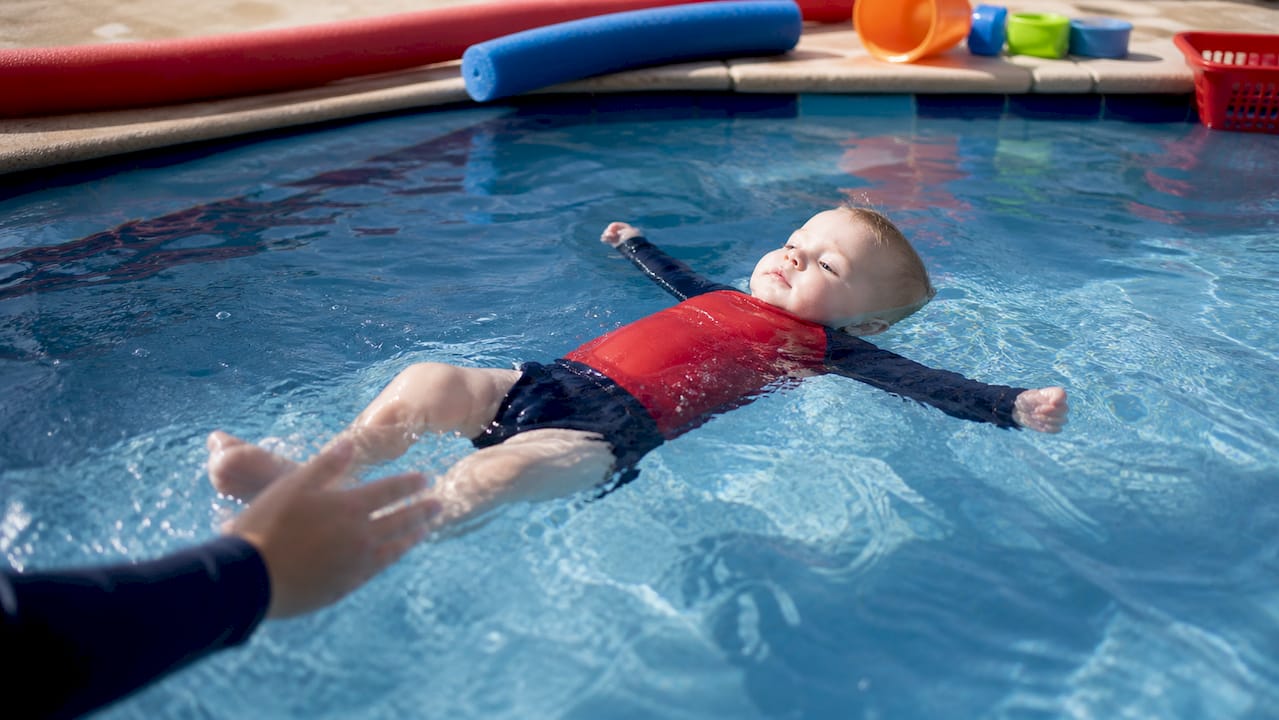
Water competency is the broader survival framework, covering the judgment, awareness, and physical skills needed to avoid and survive a drowning situation. Swimming is one narrower piece of that framework, the physical technique of moving through water. Water competency predicts survival in unexpected water incidents far better than stroke skill alone, and even a confident swimmer can drown without it. No amount of lessons makes any child drown-proof.
TL;DR:
Water competency encompasses hazard recognition, safety skills, and helping others, which are essential for real-world water survival beyond basic swimming ability.
Teaching the five key survival skills—entry and float, orientation, swimming 25 yards, and exiting without aid—is vital for effective water-competency programs and is rarely addressed in traditional lessons.
Water skills learned in pools do not automatically transfer to lakes, rivers, or the ocean, emphasizing the importance of environment-specific practice and layered safety measures.
Formal swim lessons can reduce drowning risk by about 88%, but they must be paired with year-round practice and active supervision to be truly effective.
Prioritizing programs that focus on survival tasks, instructor credentials, and ongoing skill refreshers helps ensure children develop real water competency, not just swimming strokes.
Table of Contents
The Five Survival Skills Every Water-Competency Program Should Teach
How Parents Should Choose Lessons, Supervise, and Maintain Skills
How Superhero Swim Academy Builds Water Competency Into Every Lesson
Common Misconceptions About Water Competency and Swimming Ability
How to Reliably Test Water Competency Versus Swimming Skills
Water Competency vs Swimming: The Conceptual Difference
Swimming lessons teach a child to move through water efficiently. That’s it. Freestyle, backstroke, kicking technique, breath control for speed. Useful, but narrow. It answers one question: can this child propel their body through calm, familiar water?
Water competency asks a bigger question: can this child survive water they didn’t expect to be in? The American Red Cross breaks it into three components:
Water smarts — recognizing hazards, understanding currents, knowing your own limits, and following rules like never swimming alone.
Basic swimming and water safety skills — the physical tasks that let someone survive an unplanned entry into water, not just perform strokes on command.
Helping others — knowing when and how to assist safely, including calling for help and using the reach or throw, don’t go principle instead of jumping in.
A World Health Organization synthesis on drowning prevention frames this the same way: skill training only reduces mortality meaningfully when it’s paired with judgment and safety education, not delivered as isolated stroke instruction. A child who can swim a beautiful 25 meters in a warm, calm pool but panics when they fall into a lake fully clothed has swimming skill without water competency. That gap is where most drowning incidents happen.
The Five Survival Skills Every Water-Competency Program Should Teach
Ask any program what it teaches, and you should hear some version of these five tasks, drawn directly from Red Cross-style water competency benchmarks:
Step or fall into water over your head, then return to the surface. This simulates an accidental entry, the way most drowning incidents actually start.
Float or tread water for at least one minute. Not sprint. Float. This buys time for the brain to catch up and decide what to do next.
Turn around in a full circle to find an exit. Disorientation kills. A child who panics and swims toward a wall instead of the ladder is in real danger.
Swim at least 25 yards. Enough distance to reach a pool edge, boat, or dock from typical open-water falls.
Exit the water without a ladder when needed, pulling themselves up and out safely.
Pro Tip: Ask a prospective swim program to walk through these five tasks specifically. If they only describe stroke drills and lap counts, you’re looking at a swimming lesson, not a water-competency program.
Some programs extend the distance requirement or add clothing drills, since clothed swimming is dramatically harder than swimming in a suit. That variation matters. A child who passes the basic benchmark in trunks may struggle badly in jeans and sneakers, which is closer to how real accidental falls happen.
What the Research Says About Lessons and Water Competency
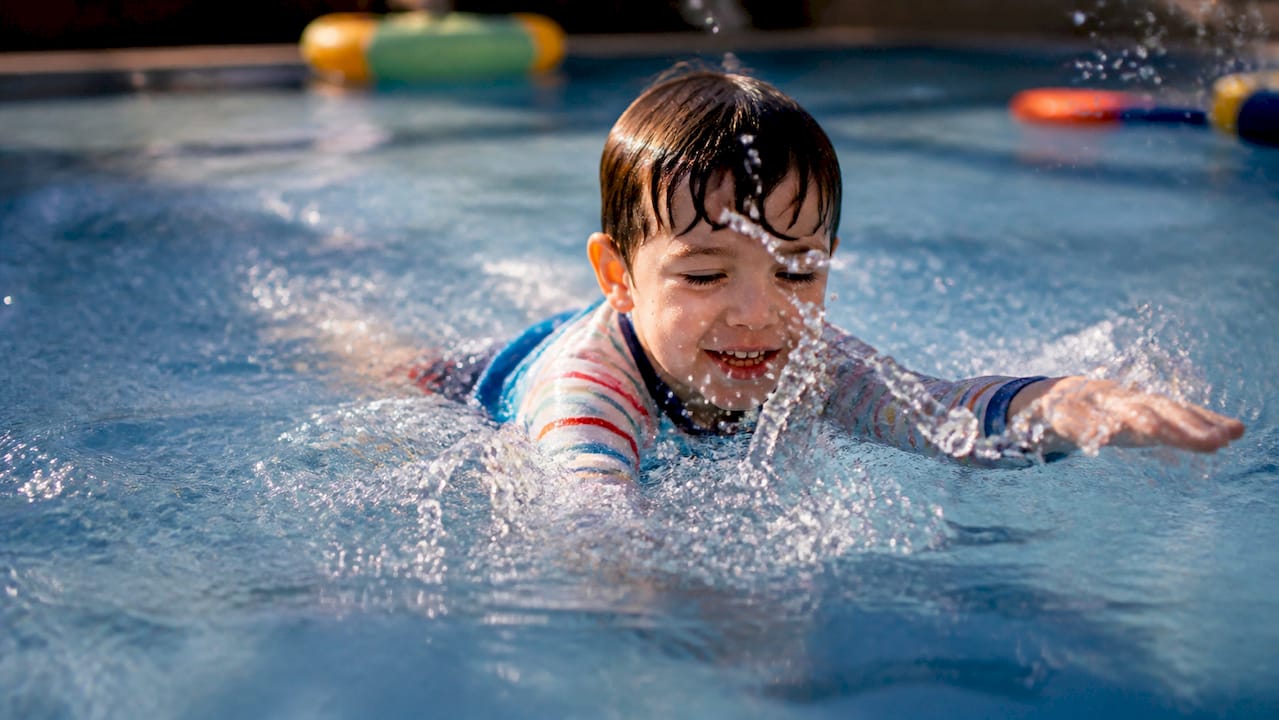
The headline number parents should know: formal swim lessons for children ages 1 to 4 are associated with roughly an 88% reduction in drowning risk, according to observational studies cited in pediatric drowning-prevention literature. That’s a substantial effect for a single intervention.
It comes with real caveats. Most of the underlying research is observational, meaning it shows a strong association rather than airtight proof of cause and effect. The WHO systematic review on drowning prevention interventions found that combined programs, ones pairing basic swim skills with out-of-water safety education, show the most consistent reduction in drowning-related mortality. Evidence certainty varies by outcome, and researchers note that earlier training tends to compound benefits over time rather than deliver a one-time fix.
Combining water-safety education with basic swimming and water safety skills likely reduces drowning risk more than either approach alone, though the certainty of evidence differs across specific outcomes and age groups.
The limits matter just as much as the benefits:
Skills learned in a heated, chlorinated pool don’t automatically transfer to a cold lake, ocean waves, or a river current, since environmental conditions change performance substantially.
The CDC frames drowning prevention as layered protection, meaning lessons, barriers like fencing, life jackets, and active supervision, working together, never as one single fix.
A child who passes every benchmark today can lose that competency within months without practice.
How Parents Should Choose Lessons, Supervise, and Maintain Skills
Picking a program and staying vigilant afterward matters more than which brand of lesson you choose. Here’s what to actually check and do.
When evaluating a program, look for:
A curriculum built around survival tasks, not just stroke technique, similar to the survival swim approach that centers on real-world scenarios.
Instructors certified in CPR and First Aid, since an emergency in the water demands more than swim knowledge.
Small class sizes or private instruction, which lets an instructor actually watch each child’s form and reaction under stress.
Regular parent updates with measurable goals, so you know exactly what your child can and can’t do yet.
Supervision doesn’t end when lessons do. The American Academy of Pediatrics is direct about this: lessons reduce risk, they don’t replace an adult within arm’s reach of young children, known as touch supervision. Around any natural body of water, teach the reach-or-throw-don’t-go rule instead of letting anyone, child or adult, jump in as a would-be rescuer. On a boat, a life jacket beats swimming ability every time.
Maintenance is the piece most families skip. Skills fade. Year-round lessons, practicing at home between sessions, and occasional drills in cooler water or light clothing keep competency sharp instead of theoretical.
How Superhero Swim Academy Builds Water Competency Into Every Lesson
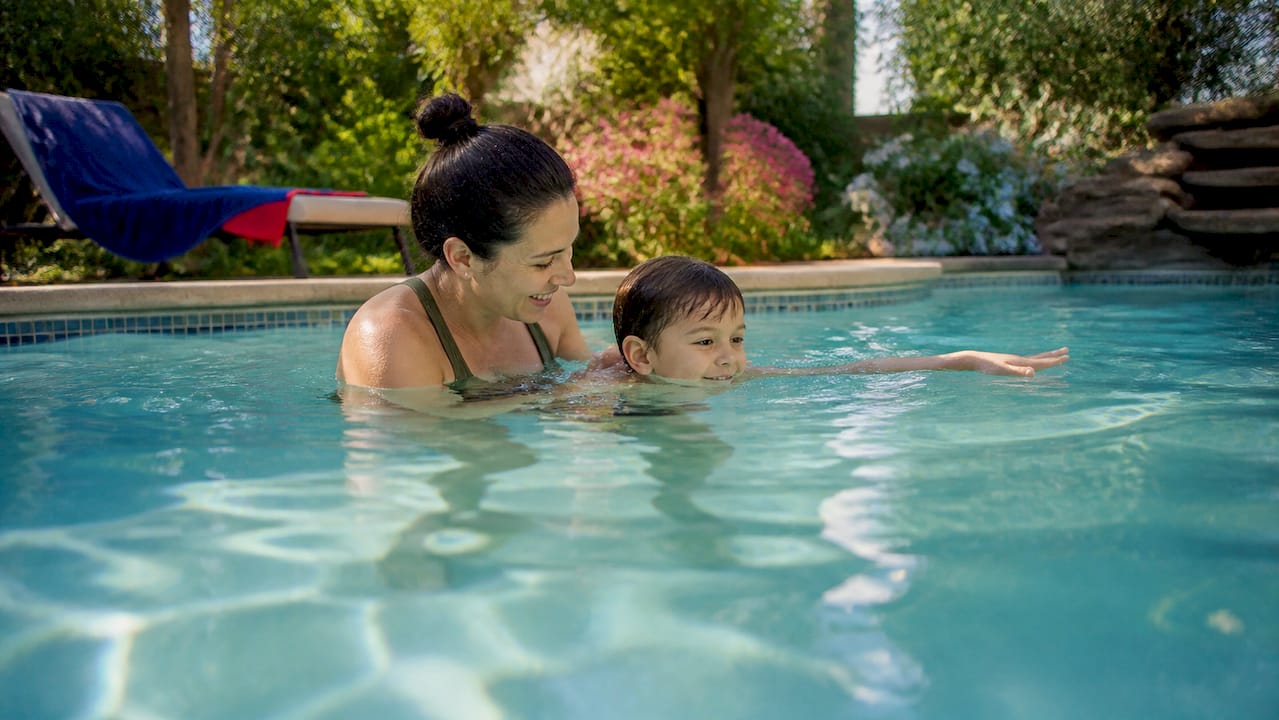
Every Superheroswimacademy instructor trains in CPR, First Aid, and a proprietary survival curriculum built around exactly the five tasks outlined above, not generic stroke drills. That’s a deliberate choice, because a child who can float, orient, and exit safely is protected in situations a stroke lesson never prepares them for.
The results back it up. Superheroswimacademy has taught more than 2,500 children, with parents reporting measurable swimming and safety improvements within short timeframes. Progress isn’t left to guesswork. Families get clear goals and regular updates, so you can see exactly which of the five survival skills your child has mastered and which need more work. That combination, qualified instructors plus small-group or private formats plus parent visibility, maps directly onto the selection checklist above.
The Bottom Line on Water Competency vs Swimming
Prioritize programs that teach survival skills, not just strokes. Keep active supervision non-negotiable regardless of lesson progress, and practice regularly since competency fades without use. Ask any program directly about the five survival tasks, instructor credentials, and how often skills get refreshed.
Comparing Skill Levels and Intended Outcomes
Swimming skill and water competency sit on different scales measuring different things, and confusing the two is where a lot of parental confidence goes wrong.
Swimming ability is usually measured by technique quality, speed, and distance in controlled conditions. A competitive youth swimmer might clock impressive times and demonstrate excellent form, all inside a lane in a calm, temperature-controlled pool. That’s a legitimate, valuable skill. It’s just not the same measurement as survival capability.
Water competency is measured by outcome under stress: can this person survive an unplanned, unfamiliar water event? The intended outcome isn’t a personal best. It’s staying alive long enough to self-rescue or be rescued. A paradigm shift in aquatic education research describes this exact distinction: the field has moved from measuring psychomotor stroke skill toward measuring integrated cognitive, affective, and physical competence under realistic conditions.
Here’s the practical difference in outcomes:
Measure | Swimming skill | Water competency |
Primary goal | Efficient movement, speed, technique | Survive and self-rescue |
Typical setting | Calm, controlled pool | Simulated real-world scenarios |
Success metric | Stroke form, lap time | Float duration, orientation, safe exit |
Clothing factor | Rarely tested | Often tested clothed |
A child can rank high on one scale and low on the other, and that mismatch is exactly what water-competency training is designed to close.
Common Misconceptions About Water Competency and Swimming Ability
The biggest misconception is straightforward: parents assume “my kid can swim” means “my kid is safe around water.” Those are different claims, and treating them as identical is genuinely dangerous.
A second misconception is that water competency is something you earn once and keep forever. It isn’t. Skills fade within months, especially in young children, which is why year-round instruction rather than a single summer course matters more than most families realize.
A third misconception treats swim lessons as a substitute for supervision. They’re a risk-reduction layer, not a replacement for an adult watching. The AAP is explicit that lessons reduce drowning risk without eliminating the need for touch supervision around young children.
A fourth, subtler misconception assumes pool skills transfer automatically to open water. They often don’t. A pool-to-open-water skill gap shows up consistently in research: currents, waves, temperature, and reduced visibility change performance in ways a backyard pool never tests. Even a child who meets every Red Cross benchmark is still considered a novice for surf, rivers, or open ocean, according to guidance from WaterSafetyUSA, and needs environment-specific practice before those settings are treated as safe.
Finally, some parents assume competitive swim training automatically builds water competency because the child spends so much time in the pool. Competitive programs build endurance and technique. They rarely test the disoriented, clothed, unplanned scenarios that water competency actually measures.
How to Reliably Test Water Competency Versus Swimming Skills
Traditional swim assessments measure the wrong things if your goal is safety. A stroke evaluation checks arm position, kick timing, and breathing rhythm. None of that tells you whether your child can survive falling into water they didn’t expect.
A reliable water-competency test looks more like a scenario than a lesson. It should include an unplanned-style entry (stepping or falling in rather than a controlled dive), at least one minute of floating or treading without touching the wall, a full rotation to locate an exit, a swim of at least 25 yards, and a self-directed exit without a ladder. These five benchmarks come straight from Red Cross-style water competency skill standards, and testing all five in sequence, without stopping to coach in between, is what separates a real competency assessment from a stroke check.
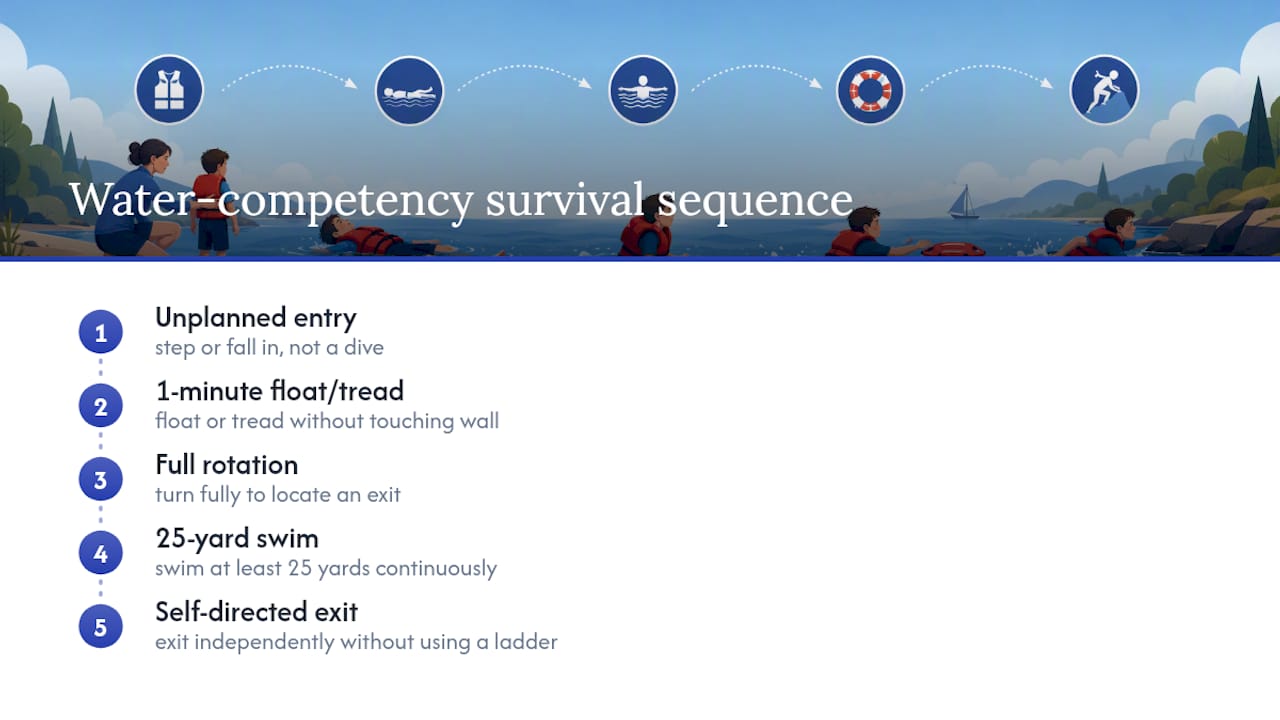
The strongest assessments add variation on purpose. Testing in light clothing, in slightly cooler water, or with a brief distraction before the entry reveals whether a skill is automatic or only works under ideal, practiced conditions. Contextualized drills like these, rather than repetitive stroke-only practice, are associated with better skill retention and transfer according to guiding principles on water competence from aquatic safety researchers.
If a program can’t describe how it tests these five tasks specifically, ask for a demonstration before enrolling. A step-by-step survival sequence that parents can watch and understand is a reasonable thing to expect, not an unusual request.
Why the Water Competency Conversation Gets Oversimplified
Most advice on this topic collapses into a single sentence: “get your kid swim lessons.” That’s not wrong, exactly. It’s incomplete in a way that matters.
The research actually supports a narrower, sharper claim: lessons help most when they teach specific survival tasks, get reinforced year-round, and never replace supervision. Conventional advice skips the maintenance piece almost entirely.
The other gap in typical advice is the assumption that a pool certificate means water-ready everywhere. It doesn’t. A child who nails every benchmark in a heated pool is still a beginner in a lake or the ocean, and pretending otherwise is how confident swimmers end up in trouble.
If there’s one thing to prioritize first, it’s asking programs pointed questions about the five survival tasks and instructor credentials, not just enrollment dates and price. Confidence in the water should come from demonstrated skill under realistic conditions, not from a certificate on the wall.
— SUPERHERO
Ready to Build Real Water Competency, Not Just Swim Strokes
Superheroswimacademy is built specifically around the water-competency gap this article just walked through. Rather than a generic stroke-focused curriculum, every lesson centers on the five survival tasks, entry, float, orientation, distance swim, and safe exit, taught by instructors certified in CPR and First Aid.
Families across Palm Beach and Broward counties choose private lessons at home, small heated-pool group classes, or parent-and-child sessions depending on what fits their schedule and their child’s needs. Every family gets clear goals and regular progress updates, so you know exactly which survival skills your child has mastered rather than guessing based on how comfortable they look in the water. With more than 2,500 children taught, the program’s track record speaks to what focused, credentialed instruction can accomplish in a short timeframe.
If your child can swim laps but hasn’t practiced falling in unexpectedly, floating, and finding an exit, that’s the gap worth closing next. Visit Superhero Swim Academy to check lesson availability and get started.
Sources
Recommended
Comments