
How to Become a Swim Instructor: Certification Roadmap
- superheroswim
- 3 days ago
- 7 min read

Get certified through the American Red Cross, the United States Swim School Association (USSSA), or U.S. Masters Swimming’s ALTS program, depending on who you want to teach. Every path requires current CPR/First Aid, documented in-water training hours, and a background check. Your first move: pick the certification that matches your target students and register for its next available course.
TL;DR:
Choosing the right certification depends on the target age group, with Red Cross BSI suited for young children and USMS ALTS for adults.
Completing at least 30 supervised hours in water training, along with current CPR and First Aid, is essential before taking the certification exam.
Certification costs vary from approximately $110 for members to $330 for non-members, with additional fees for CPR, background checks, and travel.
Specializing in infant and toddler survival swim modules or adult instruction through USMS ALTS offers quicker pathways to paid opportunities in community or private settings.
Employers prioritize documented in-water hours, current certifications, and reliability over the specific certification logo, making hands-on practice crucial.
Table of Contents
What Certification Paths Lead to Becoming a Swim Instructor?
Three organizations dominate swim instructor certification in the United States, and each one opens a different door.
The American Red Cross splits its program into two tiers. Basic Swim Instructor (BSI) qualifies you to teach parent/child classes, preschool lessons, and Learn-to-Swim Levels 1 through 3, plus private lessons. Water Safety Instructor (WSI) goes further, covering Levels 4 through 6 and adult swim instruction. If you want to work with toddlers and beginners, start with BSI. If you want the full range up through advanced adult students, WSI is the stronger long-term investment.
USSSA’s Certified Fundamental Swim Instructor (CFSI) pathway is built for people entering private swim schools rather than municipal programs, and it’s priced differently for members versus non-members.
USMS ALTS exists specifically for teaching adults, a population most other certifications treat as an afterthought.
American Red Cross BSI: parent/child, preschool, Levels 1 to 3
American Red Cross WSI: Levels 4 to 6, adult swim
USSSA CFSI: private swim school instruction, member/non-member pricing
USMS ALTS: adult learn-to-swim, community and volunteer-friendly
How Do You Actually Get Certified, Step by Step?
The process looks similar across all three organizations, even though the paperwork differs slightly.
Choose your certification based on the age group and skill level you want to teach. Working with infants and toddlers points toward Red Cross BSI. Adult-focused teaching points toward USMS ALTS.
Register and complete the online theory portion, if the program includes one, then schedule your supervised in-water sessions.
Collect signed attestation forms documenting your in-water training hours. USSSA typically requires a signed attestation covering 30 hours of supervised practice before you can sit for the exam.
Finish your CPR/First Aid certification and background check early. These prerequisites need to be approved before most organizations will let you schedule the exam.
Take the certifying exam, then track your renewal window. Most certifications require recertification every one to two years, tied to your CPR/First Aid renewal cycle.
Pro Tip: Start your in-water hours log on day one, not the week before your exam. USSSA notes that exam prerequisites, including that 30-hour attestation, must be submitted and approved before you can even book your test date, and last-minute paperwork is the most common reason candidates get delayed.
What Prerequisites Do You Need Before Applying?
Most programs set a minimum age (often 15 or 16) and require you to pass a swim skill test before enrollment, such as treading water for a set time, swimming a set distance, and demonstrating basic rescue positioning.
Current CPR and First Aid certification is non-negotiable. Career guidance from Indeed confirms that supervised practical training and current lifesaving credentials are standard across accredited programs, and that a college degree isn’t required. What matters more is proof you’ve done the work in the water, not in a classroom.
Minimum age and passing a swim skill demonstration
Current CPR/First Aid, renewed on the same cycle as your instructor cert
Background check clearance before teaching minors
Basic lesson planning and classroom management skills
What Does Certification Actually Cost, and How Long Does It Take?
USSSA’s CFSI pathway lists a cost example of $110 for members versus $330 for non-members, a gap wide enough to make joining a member swim school worth considering before you enroll. On top of the course fee, budget separately for CPR/First Aid class fees, background check processing, and travel to in-water sessions if your program doesn’t run locally.
Candidates usually spend some weeks completing the required hours, depending on how quickly they can schedule supervised pool time. Blended learning models, meaning online theory paired with in-person practice, cut down classroom hours but don’t shorten the in-water requirement.
Course fee (varies by member status and organization)
CPR/First Aid course, typically a separate fee
Background check processing fee
Liability insurance if you plan to offer private lessons
Which Specializations Pay Off Fastest?
Infant and toddler survival swim modules carry outsized value because relatively few instructors complete them, and parents actively seek out instructors trained in this niche. These modules typically require additional supervised hours focused on breath control, water re-entry, and float positioning for very young children.
USMS ALTS opens a different door entirely: adult instruction. Community centers, YMCAs, and workplace wellness programs regularly need adult-focused instructors, and volunteer coaching experience through ALTS often becomes the fastest route into paid community program work.
Infant/toddler survival modules: high demand, added in-water hours
USMS ALTS: adult learn-to-swim, community program pipeline
Coaching credentials: a common next step for instructors moving into supervisory or director roles
What Do Swim Schools Actually Look for When Hiring?
Employers care less about which certification logo is on your card and more about what it proves. Documented in-water hours, current CPR/First Aid, and completed infant/toddler modules signal readiness faster than a resume line item.
Getting those hours before you’re fully certified usually means volunteering, taking an assistant instructor role, or shadowing a mentor at a community program. If you plan to teach privately once certified, factor liability insurance into your setup costs early, it’s a common operational expense that catches new instructors off guard; many instructors find opportunities through established franchises like Aqua-Tots Swim Schools which offer career paths and employer support.
Documented in-water hours and references from a supervising instructor
Current CPR/First Aid and completed specialty modules
Reliability and communication skills employers rate as highly as technical swimming ability
Pro Tip: Ask your certifying mentor for a written reference the same week you finish your hours, while your performance is still fresh in their memory.
How Does Superhero Swim Academy Train Certified Instructors?
Superhero Swim Academy builds its instructor training around the same components national certifying bodies expect: current CPR and First Aid, a proprietary survival swim curriculum, and structured in-water mentorship with documented hours.
Candidates work alongside experienced instructors to accumulate the supervised practice time that programs like USSSA require for attestation, while learning a survival-focused teaching approach built specifically for infants and toddlers. The academy has taught more than 2,500 children in Palm Beach and Broward counties, with parents receiving regular progress updates throughout each session block.
CPR and First Aid training integrated into the instructor path
Proprietary survival swim curriculum for infant and toddler specialization
Mentored in-water hours with documentation support for national cert attestation
Track record: 2,500+ children taught, parent communication built into every course
Why Hands-On Training Beats a Theory-Heavy Shortcut
The strongest predictor of instructor readiness isn’t how many videos someone watched, it’s how many hours they spent in the water with a mentor correcting their technique in real time. Programs that front-load theory and rush the in-water component tend to produce instructors who freeze the first time a toddler panics mid-lesson.
Choose a certification path that treats supervised practice as the main event, not a checkbox. Everything else, the exam, the paperwork, the renewal cycle, is secondary to whether you’ve actually taught real children under real conditions.
— SUPERHERO
Train With Superhero Swim Academy’s Instructor Program
Superhero Swim Academy gives you a shorter, more supervised path to instructor readiness than piecing together hours on your own. Instead of hunting for pool time and a willing mentor, you get structured in-water mentorship, CPR and First Aid training, and help documenting the hours national certifying bodies require for attestation, all built around the academy’s survival swim curriculum that’s already taught more than 2,500 children in Palm Beach and Broward counties.
Whether you’re starting from scratch or adding an infant/toddler specialization to an existing certification, the online courses walk you through the same fundamentals the academy uses in its own in-person training. Visit Superhero Swim Academy to see current instructor training openings and start booking your mentored in-water sessions.
Where to Register and Verify Requirements
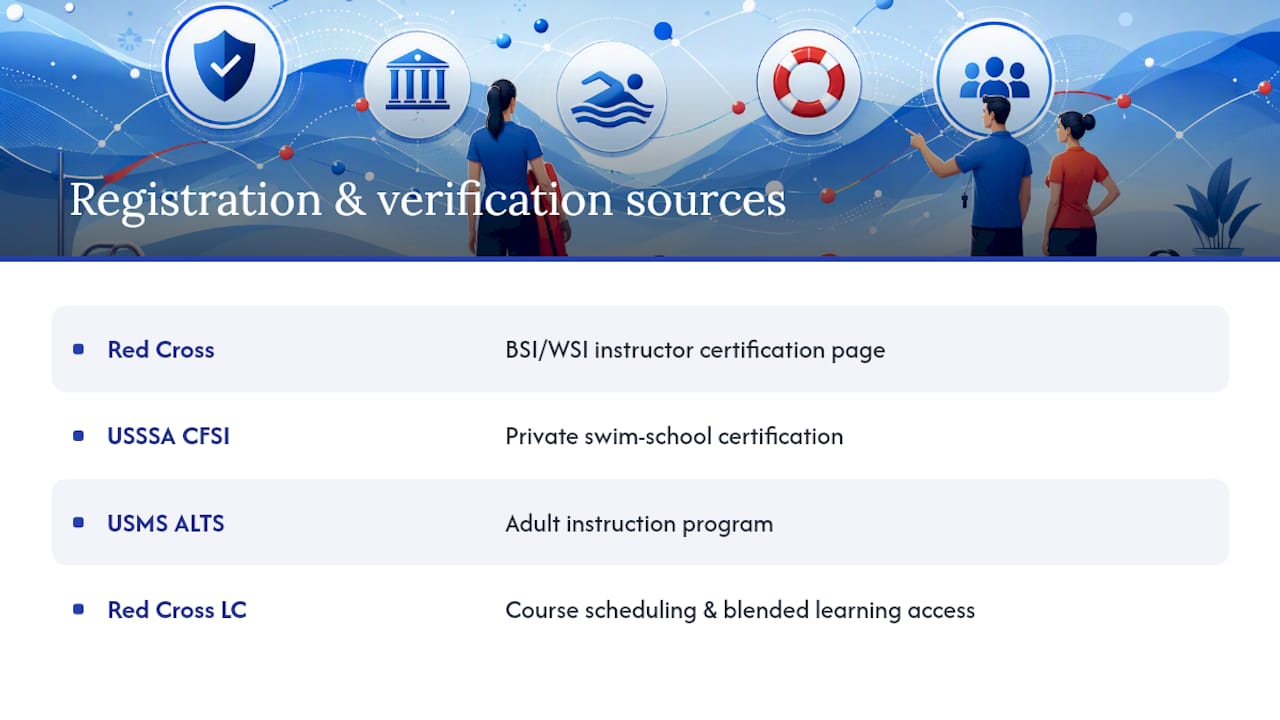
Register directly through official pages: the Red Cross instructor certification page for BSI/WSI, the USSSA CFSI application for private swim school certification, and the USMS ALTS program for adult instruction. Use the Red Cross Learning Center for course scheduling and blended learning access. These pages hold the current prerequisites and forms, don’t substitute a summary for the original application.
Sources
Recommended
Comments