
Florida Pool Fence Requirements: What Every Owner Must Know
- superheroswim
- 3 days ago
- 9 min read

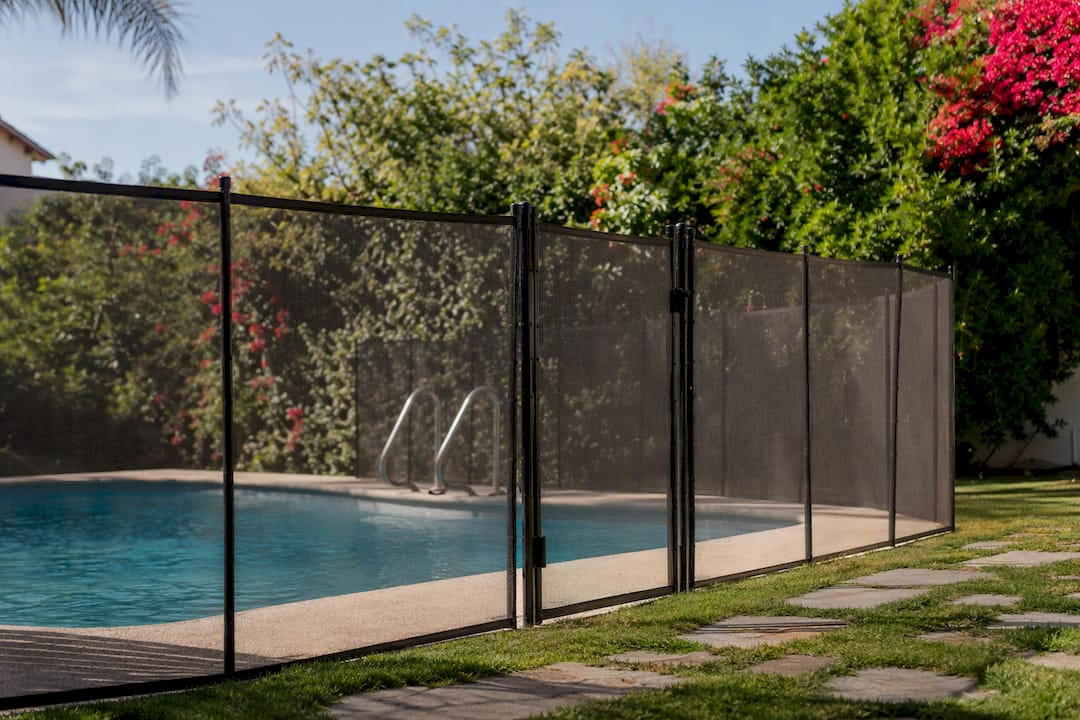
Florida law gives homeowners two paths to a legal pool: build a barrier that meets Chapter 515’s specifications, or equip the pool with at least one of five statutory safety features that let it pass final inspection without a full-perimeter fence. Either path satisfies the Residential Swimming Pool Safety Act, but most homeowners find one of the five features faster and cheaper than starting from scratch.
The five statutory options are:
An isolation enclosure that meets the barrier standards in section 515.29
An approved safety pool cover certified to ASTM specifications
Exit alarms rated at least 85 dB(A) at 10 feet on doors and windows with direct pool access
Self-closing, self-latching devices with a release mechanism at least 54 inches above the floor
An ASTM F2208-certified pool alarm
If an inspector cites your pool for missing one of these, Florida statute gives you 45 days to fix it and attend a drowning prevention education program before penalties apply. Keep in mind that counties like Miami-Dade often layer stricter rules on top of the state minimum, so the state statute is the floor, not necessarily the finish line.
Table of Contents
What Are Florida’s Pool Fence Requirements Under State Law?
Florida Statute 515.29 sets the baseline every barrier must clear, and it’s more specific than most homeowners expect. The barrier has to stand at least 48 inches (4 feet) high, measured on the outside where a child would be standing when trying to climb over. That detail trips people up constantly: measuring from the inside of a sloped yard can make a fence look compliant when it isn’t.
Height alone doesn’t satisfy the statute. The design also has to block a young child from crawling under, squeezing through, or climbing over it, which rules out large horizontal gaps, decorative cutouts a small foot could use as a step, and any structural member positioned as an accidental ladder. Miami-Dade’s own permitting guidance flags horizontal rails and decorative features within roughly 900 millimeters of the top rail as a common failing point during inspection, since they turn an otherwise legal fence into a climbable one.
Three additional placement rules matter just as much as height:
The barrier has to surround the entire pool perimeter, not just the side facing the house.
A standard yard fence does not count as a pool barrier unless it independently meets every requirement of 515.29 — this is the single most common reason homeowners fail their first inspection, since a six-foot privacy fence around the whole yard feels like protection but usually isn’t isolating the water itself.
The barrier must sit far enough back from the water’s edge that breaching it doesn’t drop a child straight into the pool.
The 4-foot rule in practice: Inspectors check outside height at multiple points around the perimeter, not just one spot near the gate. A fence that measures 49 inches by the gate but sags to 44 inches on a side stretch fails the whole barrier, not just that section.
What Are the Five Statutory Compliance Options?
Chapter 515 doesn’t force every pool owner into the same isolation-fence model. Legislators built in five alternatives precisely because a single mandatory design doesn’t fit every property, and each option comes with its own trade-offs.
Isolation enclosure: A dedicated fence around just the pool, separate from the yard fence. This is the gold standard inspectors look for first, and it’s the option that requires no ongoing electronic maintenance.
Approved safety pool cover: Must meet the ASTM F1346 standard for power safety covers. These work well for pools that sit uncovered for only part of the year, but they demand consistent use. A cover left open overnight offers zero protection.
Exit alarms: Installed on doors and windows with direct pool access, rated at minimum 85 dB(A) at 10 feet. The most common failure here isn’t the alarm itself but a dead battery or a homeowner who disabled it because it kept going off during normal foot traffic.
Self-closing/self-latching devices: The release mechanism can’t sit lower than 54 inches, keeping it out of reach for most young children. Placement on interior doors is the detail installers miss most often.
ASTM F2208-certified pool alarms: These come in several detection types, including surface motion, sub-surface pressure, sonar, and infrared. Surface-motion alarms are prone to false triggers from wind and rain, so budget for occasional nuisance alerts if you choose this route.
Pro Tip: If you’re weighing a cover against an alarm, remember covers require you to physically close them every single time, while alarms work passively. For families with young kids in and out of the yard all day, an alarm plus a latching gate usually holds up better than relying on a cover you might forget to close.
How Should Pool Gates and Access Points Be Configured?
Gates cause more failed inspections than almost any other single component, mostly because the fixes are mechanical rather than structural. The statute requires gates to swing outward, away from the pool, and to be both self-closing and self-latching.
Here’s where homeowners get tripped up:
Swing direction: A gate that swings toward the pool lets a child’s weight push it open. It has to swing away from the water.
Latch placement: The release has to sit on the pool side of the gate, positioned high enough that a small child reaching over or through the gate can’t trigger it.
Door and window thresholds: Any door or window offering direct pool access typically needs its own exit alarm or self-closing/self-latching device, even if the yard already has a compliant fence elsewhere.
Quick inspector-approved fixes: Adjusting hinge tension to force the swing outward, raising a latch that sits too low, adding a latch shield to block reach-through access, or installing a door alarm on a problem entry point.
Pro Tip: Before your inspection, walk every gate and door yourself and let it close on its own from a foot away. If it doesn’t latch every single time without your hand touching it, an inspector will catch it too.
Can an Aboveground Pool’s Structure Count as the Barrier?
Yes, in many cases. If the pool wall itself stands tall enough and is genuinely non-climbable, the structure can serve as the required barrier without an additional fence around it. The catch is the ladder or steps used to get in and out.
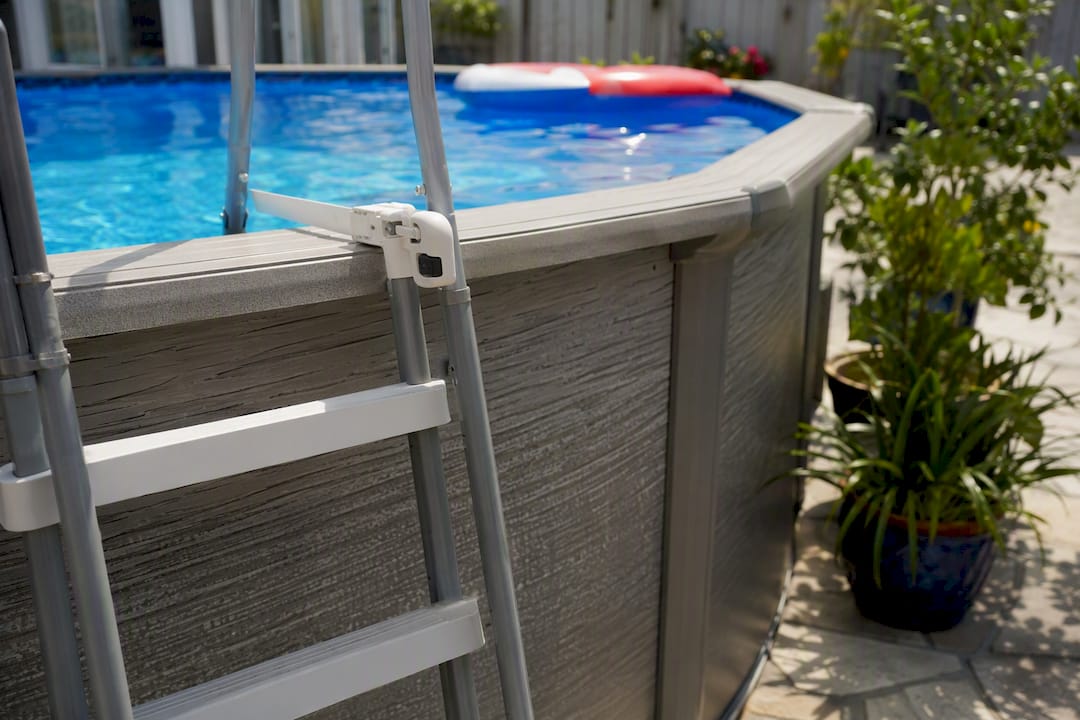
Any ladder or step attached to the pool has to be secured or removed when the pool isn’t in use, since a fixed ladder essentially defeats the whole point of using the wall as a barrier. Inspectors will specifically check whether a removable ladder is disconnected and stored away, or whether it locks in a raised position.
A quick checklist for aboveground pool owners:
Confirm the pool wall height matches or exceeds the 48-inch outside measurement.
Install a lockable or removable ladder, and actually use it that way, not just own one.
If a wall of your house forms part of the enclosure, treat any door or window opening onto that side as an access point needing its own alarm or self-latching device.
Check for gaps between deck attachments and the pool wall that a child could use as a foothold.
What Happens During Inspection and What Are the Penalties?
Inspectors run through a fairly consistent checklist: barrier height at multiple points, gate swing direction and latch function, alarm sound tests, device release heights, and any climbable gaps or protrusions. Miami-Dade’s own inspection materials note that most failures trace back to simple mechanical issues rather than fundamental design flaws, which is good news if you’re staring down a citation.
Failing to equip a pool with a required safety feature is a second-degree misdemeanor under Florida law. That sounds alarming, but the statute builds in real relief: if you correct the issue within 45 days of citation and attend a drowning prevention education program where one is offered, the penalty is waived entirely.
If you fail inspection, the practical next steps are straightforward:
Document exactly what the inspector flagged, in writing if possible.
Fix the specific issue (adjust the gate, raise the latch, replace a dead alarm battery) rather than guessing at a full rebuild.
Schedule reinspection promptly, well inside the 45-day window.
Attend the required education program if your county offers one, since it can be the difference between a waived penalty and a formal misdemeanor charge.
Do Local Counties Add Their Own Pool Barrier Rules?
State law sets the floor, and counties across Florida routinely build on top of it. Miami-Dade County publishes its own barrier guidance with specific permitted designs and permitting steps that go beyond section 515.29. Palm Beach and Broward counties, where many Florida families are weighing backyard pool projects, can carry their own local amendments as well.
Before you install anything, it’s worth a direct call or visit to your local building department rather than assuming the state statute is the whole story. A few practical steps:
Check your county or city building department’s website for pool barrier or fence permit pages.
Ask specifically whether your barrier design requires a permit before construction, which is common for new installations and major fence replacements.
Have your pool’s site plan, proposed fence height, and gate hardware specs ready, since that’s the documentation most permit offices request up front.
Confirm whether your county has adopted stricter height, setback, or gate requirements than the state minimum.
How Should Barriers Fit Into a Broader Home Safety Plan?
A compliant fence keeps you legal. It doesn’t, by itself, keep a child safe every time. That gap is the whole reason the statute allows multiple safety layers instead of mandating a single design, and it’s the reason Superheroswimacademy pushes families toward a layered approach: a code-compliant barrier, at least one detection feature like an alarm, and water competency training the child actually carries with them.
Superheroswimacademy’s instructors are trained in CPR, First Aid, and the academy’s own survival swim curriculum, and the program has taught more than 2,500 children across Palm Beach and Broward counties.
A fence stops a child from reaching the water unsupervised. Swim training changes what happens in the seconds after a child ends up in the water anyway, whether that’s from a gate left open or a barrier a toddler found a way around.
A few concrete next steps for families:
Walk your property with the checklists above before your next inspection or renewal.
Pair your compliant barrier with an ASTM-certified alarm as a second layer of detection.
Enroll young children in age-appropriate survival swim lessons so water competency backs up the physical barrier.
If you’re ready to add that training layer, Superhero Swim Academy’s Palm Beach and Broward lesson programs offer private, in-home, and small-group survival swim instruction built around exactly this kind of layered safety approach. Parents outside driving distance can also explore the online courses that teach parents to instruct their own children in survival swim fundamentals.
What Should Homeowners Remember About Florida Pool Fence Requirements?
Meeting Florida’s pool barrier law requires a 48-inch non-climbable enclosure, a compliant gate, and at least one of five statutory safety features working together, not any single element alone.
Point | Details |
Minimum barrier height | Build to at least 48 inches measured on the outside, checked at multiple points around the perimeter. |
Five compliance paths | Choose from isolation enclosure, safety cover, exit alarms, self-latching devices, or a certified pool alarm. |
Gate mechanics matter most | Outward swing, self-closing, self-latching, with the release on the pool side and out of reach. |
45-day cure window | Fix a citation and attend education programming within 45 days to avoid the second-degree misdemeanor penalty. |
Local rules can be stricter | Confirm county-specific requirements with your local building department before installing or modifying a barrier. |
Is a Legal Fence Actually Enough to Keep a Child Safe?
Most articles on this topic stop at the statute, list the five options, and move on. That misses the more important question: which of the five actually gets used correctly, day after day, by a tired parent with three other things happening at once?
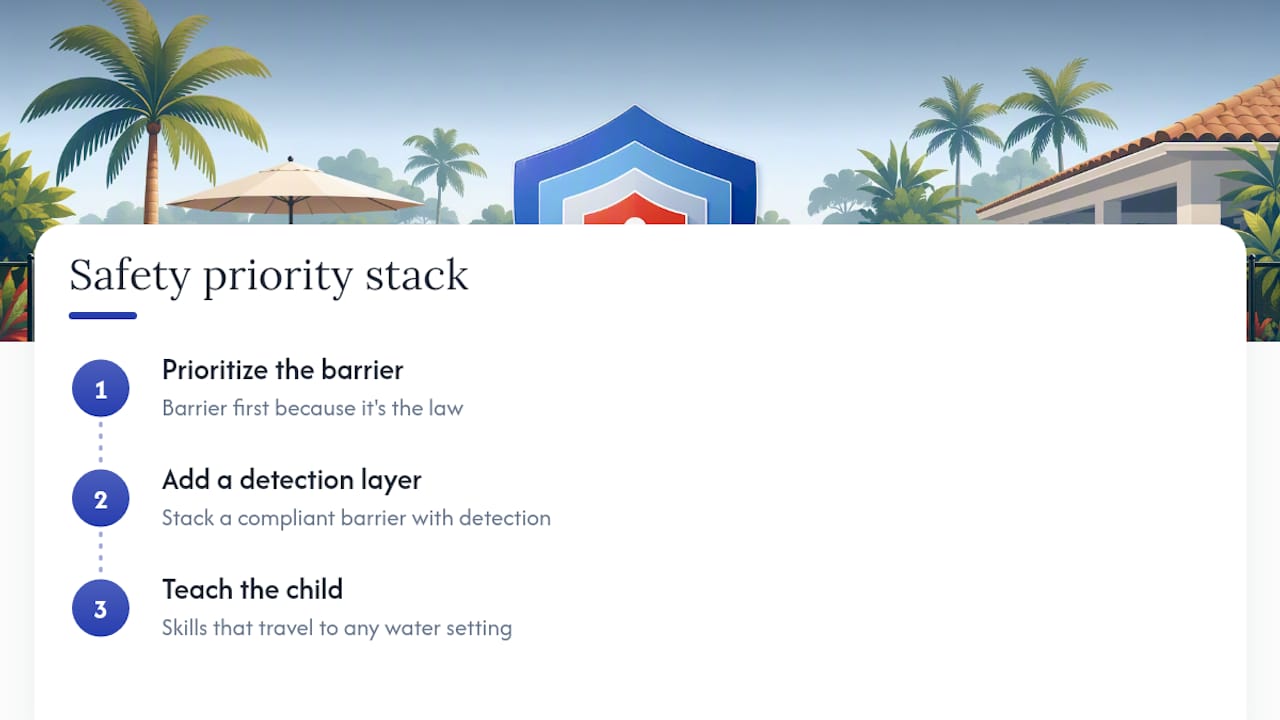
A safety cover only works if someone closes it every time, and pairing it with expert advice like the water-safety best practices podcast can help families stay vigilant. An alarm only works if the battery gets replaced and nobody disables it out of annoyance at false alerts. An isolation fence with a self-latching gate is the option that asks the least of you day to day, which is probably why inspectors treat it as the gold standard even though the law doesn’t require it over the alternatives.
The conventional advice treats compliance as the finish line. It isn’t. A fence that passes inspection can still fail a family on the one day someone leaves a gate propped open for the pool guy. What actually matters is stacking a compliant barrier with a genuine detection layer and, critically, teaching the child something that travels with them wherever there’s water, whether that’s a neighbor’s pool, a lake, or a hotel balcony rail. Prioritize the barrier first because it’s the law, then close the gap the law can’t close.
— SUPERHERO
This article is general information, not a substitute for advice from a qualified lawyer. Consult a qualified legal professional about your own circumstances before acting on anything here.
Sources
Recommended
Comments