
Ditch 'Dry Drowning': Secondary Drowning Symptoms and 0–24 Hour Rules
- superheroswim
- 10 hours ago
- 8 min read

If a child or adult develops new or worsening breathing problems, persistent coughing, or changes in behavior after being submerged, even hours later, seek emergency care immediately. The old labels “dry drowning” and “secondary drowning” oversimplify what’s actually happening: water reaching the lungs during a submersion event. Watch closely for coughing that worsens, labored breathing, confusion or extreme sleepiness, and blue or pale skin. Any of those means the emergency department, not a wait-and-see approach at home.
TL;DR:
Symptoms such as persistent cough, labored breathing, or blue lips may develop hours after submersion and require immediate emergency care.
Most symptoms appear within 4 to 8 hours but can extend to 24 hours; any worsening or new symptoms after this period are unlikely related.
Objective signs like chest retractions are critical indicators, and a breath rate above 40 in toddlers or 20 in older children warrants medical attention.
Emergency evaluation includes a physical exam, pulse oximetry, chest x-ray, and possibly blood tests, with observation lasting several hours to monitor for delayed complications.
Prevention relies on layered safety measures such as supervision, fencing, life jackets, lifeguards, and survival swim lessons to reduce drowning risks.
Table of Contents
Secondary Drowning Symptoms: What Parents Should Watch For
Medical groups have largely retired the terms “dry drowning” and “secondary drowning” because they suggest something mysterious and separate from ordinary drowning. It isn’t. The American Red Cross recommends caregivers stop chasing labels and start watching for concrete, observable signs instead. That shift matters because it puts the focus where it belongs: on symptoms you can actually see and act on.
Water that reaches the lungs during a submersion event, even a brief one that looked more like a scare than an emergency, can irritate lung tissue and trigger fluid buildup over the following hours. The result is a set of respiratory and neurological signs that build gradually rather than announcing themselves all at once.
Here’s the full list of what to watch for:
Persistent or worsening cough that doesn’t ease up or gets more frequent
Fast or labored breathing, including breathing that looks like work rather than something automatic
Chest retractions, where the skin pulls in between the ribs or above the breastbone with each breath
Cyanosis, a blue or gray tinge around the lips, fingertips, or face
Vomiting, especially repeated episodes after the water exposure
Extreme fatigue or lethargy that goes beyond normal post-swim tiredness
Confusion or noticeable behavioral change, including unusual irritability or being hard to rouse
Age changes what these signs look like in practice. Infants can’t tell you they feel wrong, so watch for poor feeding, unusual fussiness, or a baby who seems less responsive than normal. Toddlers might drool more than usual or fall into a deep, hard-to-explain sleepiness shortly after a pool session. Older kids and adults tend to report it directly: chest pain, a scratchy or different-sounding voice, or trouble getting words out clearly.
Chest retractions deserve special attention because they’re objective, meaning you don’t have to guess. Pull up your child’s shirt and watch the area around the ribs and collarbone while they breathe. If skin is visibly sinking in with each inhale, that’s the body working harder than it should to move air, and it’s not something to monitor at home overnight.

Pro Tip: Count breaths for 30 seconds and double it. A resting rate consistently above 40 breaths per minute in a toddler, or above 20 in an older child or adult, is worth a call to your pediatrician or a trip to the ED, especially paired with any other sign on this list.
Roughly 4 to 8 hours after a submersion event is when most symptoms tend to surface if they’re going to appear at all, which is exactly why the next section matters as much as this one.
When Do Secondary Drowning Symptoms Appear? A Timeline
The window that matters most runs from immediately after the incident to about 8 hours later. Cleveland Clinic notes that most clinically relevant symptoms show up within that stretch, though some sources extend the watch period to 24 hours as a conservative outer boundary. New symptoms appearing days later are unlikely to be connected to that particular pool day.
Here’s a simple triage rule to keep in your back pocket:
Any new or worsening respiratory or neurological symptom, at any point after submersion, means the emergency department. Not urgent care, not “let’s wait until morning.”
No symptoms and normal behavior in the first hour generally means you can shift into a longer observation period at home rather than rushing anywhere.
During that home observation window, keep the child warm and dry, check on them every hour, and write down anything that changes, however small it seems.
If you’re unsure whether something counts, call your pediatrician’s after-hours line rather than guessing. A quick phone conversation beats a missed warning sign.
The goal isn’t paranoia. It’s knowing which window you’re in and what that window calls for.
What Happens in the ER: Diagnosis and Evaluation
Emergency clinicians move through a fairly predictable sequence once a submersion patient arrives, and knowing what’s coming can take some of the edge off a frightening visit. Expect a rapid physical exam first, checking breathing effort, skin color, and alertness. Pulse oximetry clips onto a finger to measure blood oxygen in seconds. A chest x-ray usually follows to look for fluid patterns in the lungs. Bloodwork or an arterial blood gas test may be ordered if the initial picture raises concern, and continuous monitoring keeps tabs on heart rate and oxygen levels throughout the visit.
Clinical management literature on drowning shows that observation windows, commonly 4 to 8 hours, exist because mild presentations tend to either resolve or clearly declare themselves within that period. That practical window is exactly what emergency departments use to decide between sending a patient home and admitting them for further care.
That observation period isn’t a formality. It exists because complications like pulmonary edema or acute respiratory distress syndrome can develop gradually, and a patient who looks stable at hour one can look different by hour six. Clinicians are watching for that shift in real time rather than trusting a single snapshot.
A few things typically factor into whether admission follows:
Abnormal chest x-ray findings, even if the patient seems to be breathing comfortably
Oxygen saturation that dips below normal on the pulse oximeter
Any worsening trend during the observation window, rather than steady improvement
A history of prolonged submersion or loss of consciousness at the scene
Treatment and Recovery: What to Expect
Most kids who make it to the ED for observation do fine, and treatment for the ones who need it is largely supportive rather than dramatic. Supplemental oxygen is the most common intervention. Nebulized breathing treatments can ease airway irritation, IV fluids keep a child hydrated if vomiting has been an issue, and antibiotics come into play only if there’s evidence of infection. Severe cases, thankfully uncommon, may require more advanced respiratory support, including intubation.
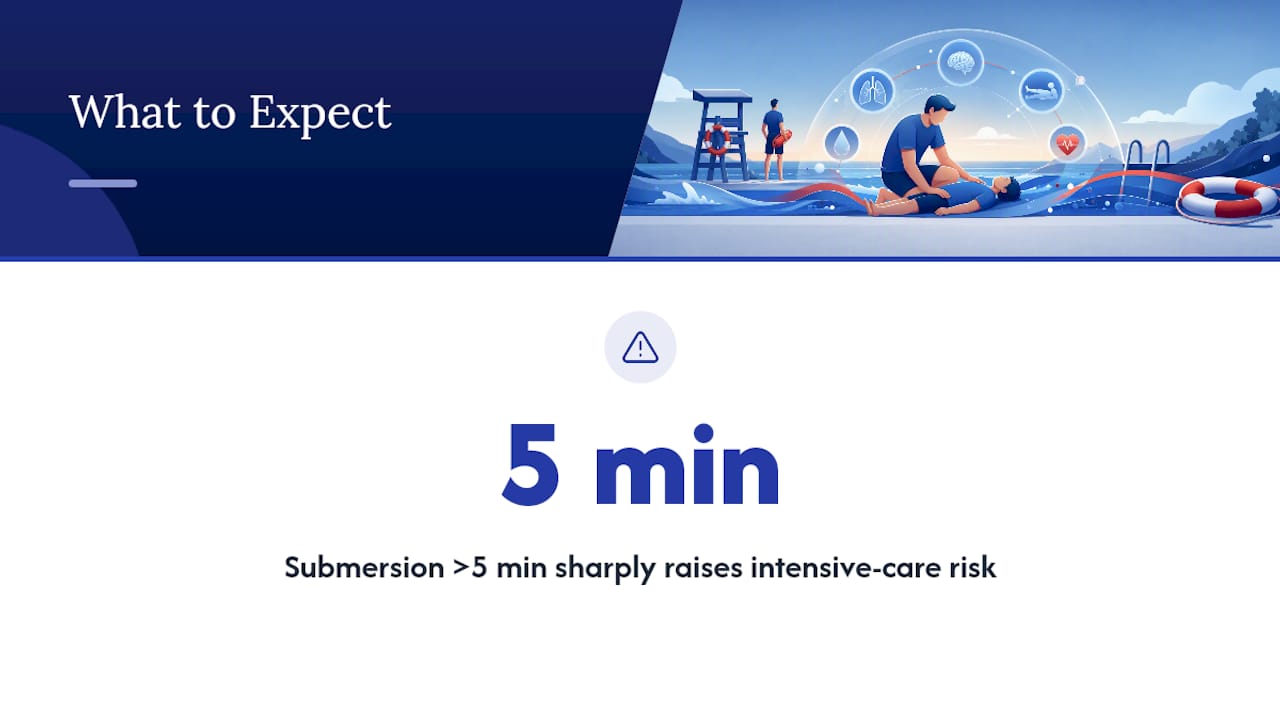
Complications track closely with how long the submersion lasted and what the initial signs looked like. Duration under water is the single strongest predictor of a rough outcome, with submersion beyond 5 minutes sharply raising the risk of oxygen deprivation and the need for intensive care. A brief dunk with immediate recovery carries a very different risk profile than a longer, unwitnessed submersion.
Discharge instructions usually include a short follow-up window and a specific list of red flags: any return of cough, breathing trouble, fever, or unusual sleepiness means going back, no second-guessing required.
Prevention Comes First: What Parents Can Do Now
The most effective response to submersion injury is never needing to respond at all. Cleveland Clinic’s guidance points to a layered prevention approach, and layering matters because no single safeguard is foolproof on its own.
Active, undistracted supervision whenever a child is near water, phone down, eyes up
Four-sided pool fencing with a self-latching gate, separating the pool from the house
Life jackets for weak or developing swimmers, especially around open water or boats
Lifeguards at public pools and beaches whenever they’re available
Survival swim lessons that teach kids to reorient, float, and breathe if they end up in the water unexpectedly
If a submersion event happens despite these layers, get the child warm and dry right away, watch their breathing closely for the hours that follow, and jot down what happened: how long they were under, whether they coughed or vomited, whether they lost consciousness. That record helps any clinician who sees them later. Call 911 immediately if the child was unresponsive at any point or is struggling to breathe now.
Pro Tip: Learn infant and child CPR before you need it, not after. A hands-only refresher course takes less than two hours, and it’s one of the few things a parent can do that directly changes the outcome of an emergency.
For families that spend time boating as well as swimming, a float plan adds another layer of preparedness, giving someone on shore a clear picture of where you’re headed and when to expect you back.
Why Survival Swim Training Belongs in Your Prevention Plan
Survival swim lessons won’t prevent every incident, and no responsible instructor would claim otherwise. What they do is stack another layer of protection on top of supervision and fencing, giving kids a fighting chance to reorient, float, and breathe if they end up underwater unexpectedly. Every instructor at Superheroswimacademy trains in CPR and First Aid alongside a dedicated survival swim curriculum, and that combination matters because a swim teacher who can also recognize and respond to a medical emergency changes what’s possible in the pool.
With over 2,500 children taught, families report real gains in water confidence and skill within a short training window. Lessons build capability, not immunity. Pair them with fencing, life jackets, and CPR training of your own, and you’ve built a genuinely layered defense rather than relying on any single piece to carry the whole load.
— SUPERHERO
Get Hands-On Support Building Your Family’s Water Safety Layer
Reading about warning signs is a start, but the strongest prevention layer is a child who already knows how to float, breathe, and reorient before panic sets in. That’s the gap Superheroswimacademy closes for families across Palm Beach and Broward counties, with private lessons at home, small heated-pool group classes, and parent-and-child sessions taught by instructors trained in CPR, First Aid, and a proven survival swim curriculum.
If you’re not local, the online courses walk parents through teaching foundational water safety skills at home, and instructors interested in the same training can pursue certification through the same program. None of this replaces fencing, active supervision, or knowing the warning signs covered above, but it gives your child a real skill set for the moment those safeguards aren’t enough. Start by exploring available lesson options for your area and getting your child on a schedule this season.
Sources
This article is general information, not a substitute for advice from a qualified doctor. Consult a qualified healthcare professional about your own circumstances before acting on anything here.
Recommended
Comments